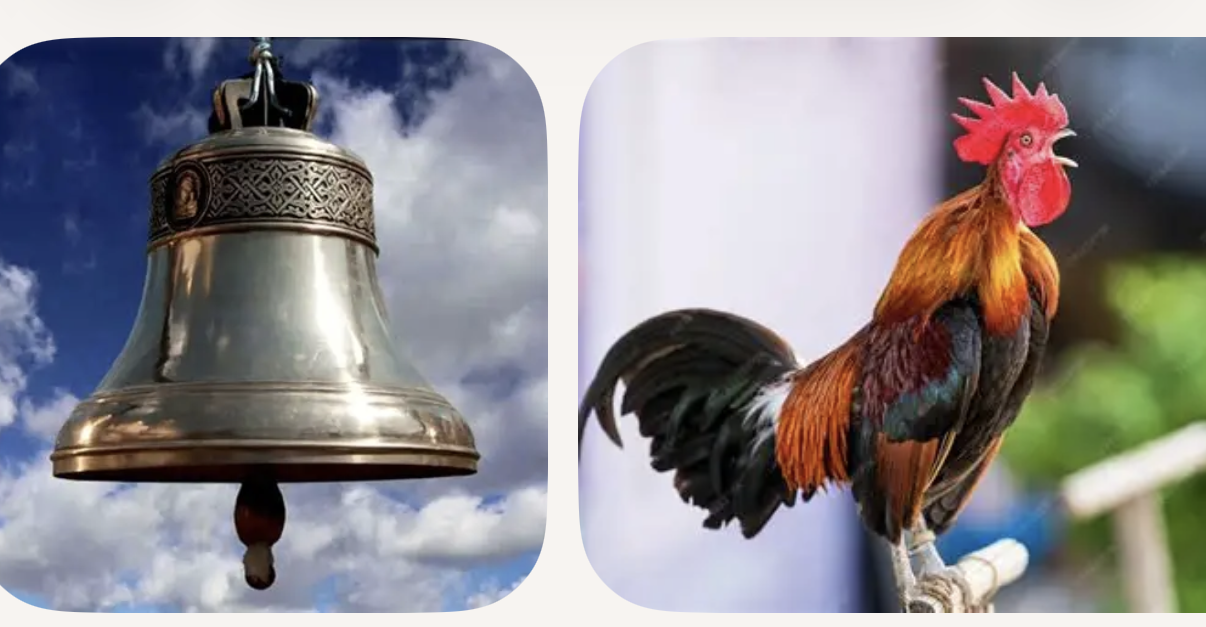
1. The bells: the voice of metal, the geometry of human time
Bells are sonic architects.
They carve time like a sculptor carves stone.
• They mark visible hours.
• They organize the community.
• They impose a social rhythm.
• They remind us of the presence of the sacred in everyday life.
They are the conscious clock, the one that man created to remind himself that he must get up, pray, work, celebrate.
They are the reason for time.
🐓 2. The rooster: the voice of life, the breath of cosmic time
The rooster, however, does not organize anything: he reveals.
He does not divide time: he announces thresholds.
• He sings before dawn.
• He perceives invisible transitions.
• He responds to subtle fields.
• He opens the gates of day.
The rooster is the instinctive clock, the one that nature has inscribed in living things so that the Earth itself can say:
“The day is returning.”
He is the intuition of time.
3. Two clocks, two worlds: the natural and the built
The rooster and the bells are not opposed: they complement each other.
• The rooster marks cosmic time.
• The bells mark social time.
The rooster said,
“This is the hour the Earth has chosen.”
Les cloches répondent :
« Voici l’heure que l’homme a fixée. »
Le coq est l’aube intérieure.
Les cloches sont l’aube extérieure.
4. Une cosmologie du rythme : l’animal et le métal comme deux pôles vibratoires
Dans une lecture cosmologique :
• Le coq appartient au royaume du souffle : il est lié à l’air, au vent, à la vibration subtile.
• Les cloches appartiennent au royaume du feu : elles sont nées de la fusion, du métal, de la forge.
Le coq est le messager du ciel.
Les cloches sont les messagères de la terre.
Le coq ouvre le jour.
Les cloches organisent le jour.
Le coq est l’intuition cosmique.
Les cloches sont la mémoire collective.
5. Ensemble, ils forment la première liturgie du temps
Avant les horloges, avant les calendriers, avant la science :
• Le coq donnait le signal naturel.
• Les cloches donnaient le signal culturel.C’était la première dualité sacrée du temps :
• Le Chant du Coq : l’heure cosmique.
• Le Son des Cloches : l’heure humaine.
Le temps était un dialogue entre le vivant et le forgé, entre l’instinct et la structure, entre le ciel et la terre.
6. Synthèse finale : le coq et les cloches comme deux battements du même cœur
Le coq est le premier souffle du jour.
Les cloches sont le premier ordre du jour.
Le coq réveille la lumière.
Les cloches réveillent les hommes.
Le coq annonce.
Les cloches confirment.
Le coq est l’aube cosmique.
Les cloches sont l’aube sociale.
Ensemble, ils forment la cosmologie du temps vécu, celle où l’homme et la nature marchent côte à côte, chacun portant une part du mystère.
Dans la Bible, le coq est surtout célèbre pour son rôle clé dans la prophétie et le récit du reniement de l’apôtre Pierre.
Le christianisme est associé à de nombreux symboles, dont le poisson, la colombe, l’agneau et, bien sûr, la croix. Un symbole ancien, que l’on trouve au sommet de nombreux clochers en Europe, est le coq. Les différentes églises donnent diverses explications à l’intégration du coq en tant que symbole du christianisme.
Dans l’art catholique, les coqs sont presque toujours associés à Pierre, sur la base des récits évangéliques du reniement du Christ par Pierre et de sa restauration ultérieure. Avant d’être arrêté, Jésus a prédit que Pierre le renierait trois fois avant que le coq ne chante deux fois le lendemain matin. Au chant du coq, Pierre s’est souvenu des paroles de Jésus et “sortit en pleurant amèrement” (Matthieu 26:75). Le coq représente le reniement du Christ par Pierre, ainsi que ses remords et son repentir lorsqu’il entend le chant du coq. Le coq, en tant que symbole, devient un appel à la repentance.
In many cultures, the rooster’s habit of crowing at dawn each morning has made it a symbol of the victory of light over darkness and the victory of life over death for Christians. Thus, some churches use the rooster as a symbol of the resurrection. Others see the rooster announcing a new day as a symbol of the Church’s responsibility to proclaim the new era of God’s grace and forgiveness to a world of darkness.
Some see in the rooster a symbol of Christ himself, the one whose coming brought the true light of the world and in whose resurrection we place our hope. It is the rooster that announces the morning, and it is Christ who announced the end of spiritual darkness and despair.
In the Middle Ages, the rooster became a popular Christian image on weathervanes. Its crowing made it an emblem of the Christian’s watchful and prepared attitude in anticipation of Christ’s sudden return, the resurrection of the dead, and the final judgment of mankind ( Mark 13:32 , 35-36 ). Like the rooster, we await the dawn.